

Performance marketing and growth marketing are often treated as competing strategies, but they solve different problems.
Performance marketing focuses on measurable acquisition and campaign efficiency. Growth marketing looks more broadly across the customer journey to find what is limiting growth.
For ecommerce and DTC brands, the better question is not “Which one is better?” It is “Where is the current growth problem?”
What Is Performance Marketing?
Performance marketing focuses on activities that can be measured against specific commercial outcomes.
Typical channels include:
- paid social
- paid search
- shopping campaigns
- affiliates
- retargeting
- landing-page testing
Common metrics include CAC, CPA, ROAS, conversion rate and revenue.
The main goal is to understand which marketing investments are producing useful business results and where budget should go next.
What Is Growth Marketing?
Growth marketing looks beyond acquisition.
It can address:
- acquisition
- conversion
- onboarding
- retention
- repeat purchase
- referral
- customer lifetime value
The focus is on identifying the biggest constraint to growth and testing ways to improve it.
That makes customer lifecycle marketing especially relevant. Acquiring more customers is useful, but growth can stall if those customers do not return.
Performance Marketing vs. Growth Marketing
| Area | Performance Marketing | Growth Marketing |
| Main focus | Acquisition efficiency | Growth across the lifecycle |
| Typical question | Which campaigns are working? | What is limiting growth? |
| Common channels | Paid search, paid social, affiliates | Paid, SEO, CRM, content, CRO, referral |
| Key metrics | CAC, CPA, ROAS, conversion rate | CAC, LTV, retention, repeat purchase |
| Scope | More specialized | Broader and cross-functional |
The biggest difference is scope.
Performance marketing usually goes deeper into acquisition. Growth marketing looks across more stages of the customer relationship.
Is Performance Marketing Only Short-Term?
No, the common idea that performance marketing is short-term while growth marketing is long-term is too simplistic.
A performance campaign can influence customers long before they buy, and paid media can provide useful insight into audience behavior, positioning and creative. The better distinction is responsibility.
A performance team may ask:
Which marketing investment is acquiring customers efficiently?
A growth team may ask:
Where in the customer journey are we losing the most growth?
Which Channels Do They Use?
There is plenty of overlap.
Performance marketing often focuses on Google Ads, Meta Ads, TikTok Ads, affiliates and retargeting.
Growth marketing may use those same channels alongside SEO, content, email, SMS, referral programs and conversion optimization.
That is why channel lists alone do not define the difference.
For brands working across several platforms, an omnichannel marketing strategy is more useful than treating each channel as a separate system.
A Simple Ecommerce Example
Imagine a skincare brand successfully acquiring customers through Meta Ads.
CAC is healthy and first-order sales look good.
But most customers never make a second purchase.
Increasing the ad budget may create more first orders, but it does not solve the real problem.
The performance team may continue improving creative, audiences and acquisition costs.
The growth team may instead test:
- post-purchase email
- replenishment reminders
- bundles
- cross-sells
- loyalty offers
That is where CRM and lifecycle marketing becomes important.
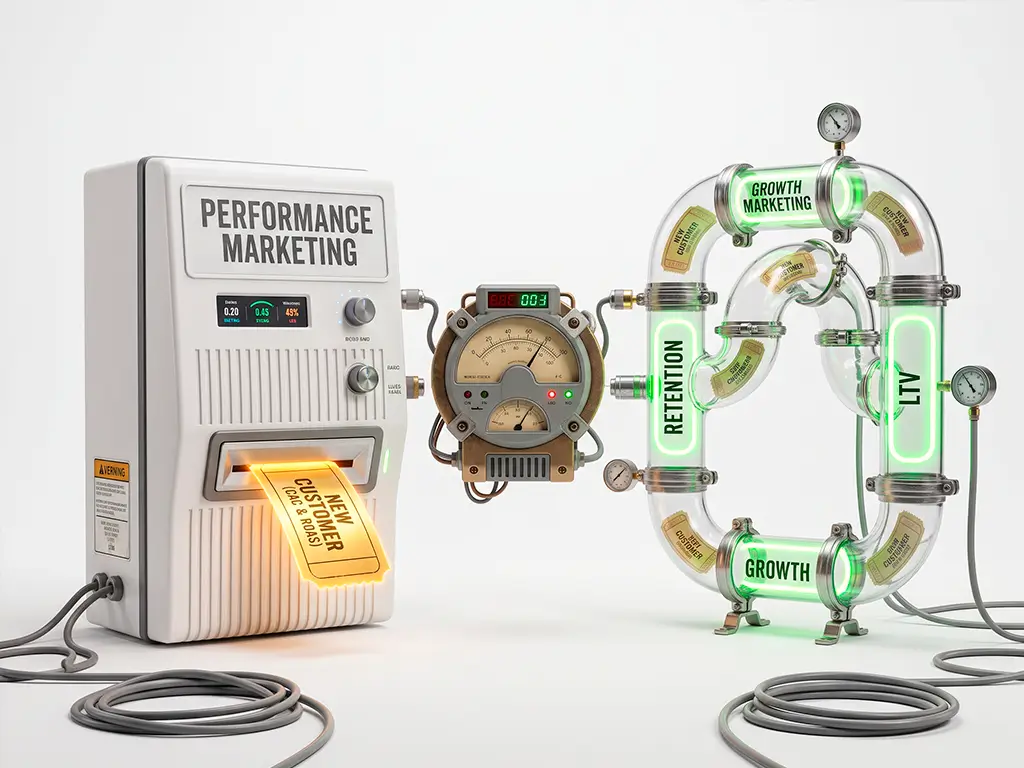
If repeat purchase improves, customer lifetime value may rise, which can then support more aggressive paid acquisition.
The two approaches can strengthen each other.
When Do You Need Performance Marketing?
Performance marketing should usually take priority when:
- not enough qualified customers are being acquired
- paid acquisition is inefficient
- CAC is too high
- campaigns need better creative or targeting
- the business needs clearer evidence about where to invest media budget
If retention and conversion are already healthy, improving acquisition may be the fastest growth opportunity.
When Do You Need Growth Marketing?
Growth marketing becomes more important when the problem sits beyond acquisition.
For example:
- plenty of traffic but weak conversion
- strong first orders but poor repeat purchase
- high customer churn
- weak onboarding
- low referral activity
- unclear customer lifetime value
In those cases, buying more traffic may only increase the number of customers entering a weak funnel.
Which Metrics Matter?
Performance teams often focus on:
- CAC
- CPA
- ROAS
- conversion rate
- revenue
- contribution margin
Growth teams may also track:
- retention
- repeat purchase
- activation
- churn
- LTV
The right metric depends on the problem being solved. A campaign can have strong ROAS but still attract low-value customers. A retention campaign can improve repeat purchase but cost too much to justify.
The Darl’s guide to marketing metrics looks more closely at choosing metrics that reflect actual business performance.
Do You Need Performance Marketing, Growth Marketing or Both?
Use the problem to decide.
| Business situation | Best starting point |
| Weak customer acquisition | Performance marketing |
| Paid media is inefficient | Performance marketing |
| Strong traffic but weak conversion | Growth / CRO |
| Strong first order but low repeat purchase | Growth / lifecycle |
| Unsure where growth is being lost | Growth analysis |
| Acquisition and retention are both working | Both |
For established ecommerce brands, using both often makes sense. Performance marketing brings customers in efficiently. Growth marketing helps increase the value of those customers over time.
What Should You Ask an Agency?
Before choosing a performance or growth marketing agency, ask what they would actually own.
Useful questions include:
- Which part of our funnel would you investigate first?
- Which metrics would define success?
- How do you connect paid media with actual revenue?
- Who owns creative testing?
- How do you evaluate customer quality after acquisition?
- How does CRM or retention data affect acquisition decisions?
A good answer should reflect your business model rather than a standard channel package.
How Do Performance and Growth Marketing Work Together?
The strongest approach connects acquisition with the rest of the customer lifecycle.
Paid media can show which messages and audiences create demand. Conversion data shows who buys.
CRM and retention data show which customers return.
Those insights can then influence how much the business should spend to acquire the next customer. That creates a feedback loop instead of separate marketing activities.
Frequently Asked Questions
What is the main difference between performance marketing and growth marketing?
Performance marketing focuses more heavily on measurable acquisition and campaign efficiency. Growth marketing looks across the full customer lifecycle for opportunities to improve growth.
Is paid advertising part of growth marketing?
It can be. Growth marketing can use paid advertising alongside other channels such as SEO, CRM, content and conversion optimization.
Is performance marketing only for short-term results?
No. The key difference is scope and responsibility, not simply time horizon.
Which is better for ecommerce?
It depends on the bottleneck. If customer acquisition is weak, performance marketing may deserve priority. If customers arrive but do not convert or return, broader growth work may be more important.
Can a brand use both?
Yes. For many ecommerce brands, performance and growth marketing work best together.
Which One Does Your Brand Need?
Performance marketing and growth marketing are not opposing strategies.
If the main problem is acquiring customers efficiently, start with performance marketing.
If acquisition works but conversion, retention or repeat purchase is holding the business back, look more broadly at growth.
For many brands, the strongest model combines both: acquire efficiently, understand customer quality, improve retention and use those insights to make better acquisition decisions.
If paid acquisition is one of your biggest opportunities, see how The Darl approaches paid media and performance.

